
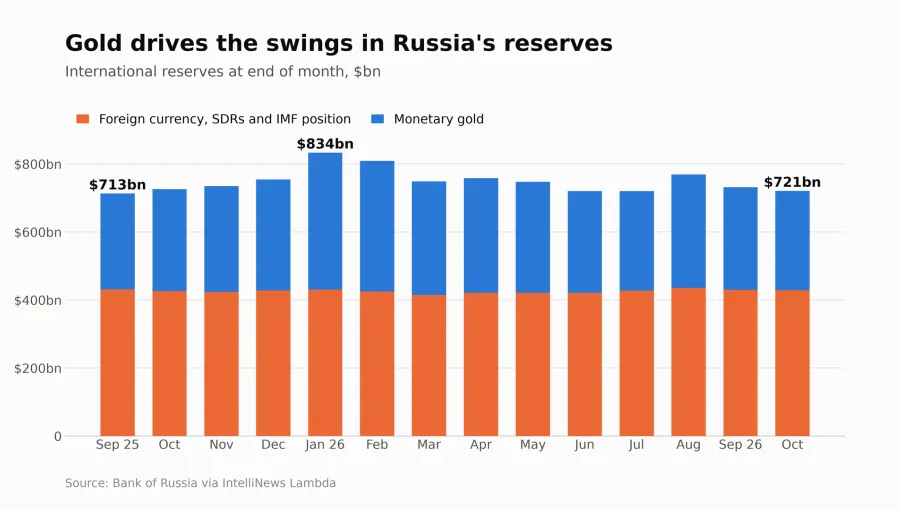
Gold prices outweigh the effect of sales
The central bank's monetary gold was valued at $292.0 billion at the end of October, down $9.6 billion during the month. The combined value of foreign currency, special drawing rights and Russia's IMF reserve position fell by $1.2 billion to $429.0 billion. Total reserves had stood at $731.8 billion on October 1.
Gold has accounted for most of the retreat from January's record. At the end of that month, reserves reached $833.6 billion, including $402.7 billion in gold. Of the $112.7 billion decline since then, $110.7 billion came from gold. Foreign currency holdings, by contrast, have remained within a $415 billion to $436 billion range at every month-end since September 2025.
October's gold-price decline came as markets anticipated higher US interest rates and a stronger dollar. Russia has also been selling metal, although those sales have had a much smaller effect on reserve values than price movements. A November 6 analysis by bne IntelliNews put September's loss in the value of the gold holdings at $31.9 billion, compared with about $0.8 billion of gold sold that month.
In the first seven months of 2026, the central bank sold nearly 50 metric tons, the largest such sales in the World Gold Council's records, as the government used the National Wealth Fund to cover its budget deficit. The council's Gold Demand Trends report, published November 3, recorded a further measure of Russia's selling: 19 metric tons in the third quarter, the only sizable reported disposal by a central bank. Globally, central banks purchased a net 321 metric tons that quarter, 42% more than a year earlier, led by China with 63 metric tons and Poland with 40.
Ukraine's Foreign Intelligence Service reported that Russia's physical monetary gold holdings fell for a tenth consecutive month in September. It put the monthly reduction at 6.2 metric tons, leaving 2,260 metric tons, the lowest level since late 2019. According to the service, holdings had declined by about 62 metric tons, or 2.7%, since December 2025.
Bullion shipments through Hong Kong
Separate reports document an increase in Russian bullion shipments to Hong Kong. The Financial Times reported in September that nearly 100 metric tons had been shipped there in the first seven months of 2026, almost three times the volume a year earlier. It valued shipments along that route since early 2022 at about $35 billion.
The Warsaw-based Centre for Eastern Studies, known as OSW, put the volume for the first eight months at 139 metric tons. It also reported that mainland China receives nearly 80% of Hong Kong's gold exports.
Only part of the wealth fund is readily available
The National Wealth Fund grew in October even as international reserves declined. The Finance Ministry reported a 70.7 billion ruble ($854 million) increase, taking the fund to 13.055 trillion rubles ($157.8 billion) on November 1, equivalent to 5.6% of forecast GDP. That recovered only some of September's 210 billion ruble ($2.5 billion) contraction, reported by Vedomosti.
Assets held in central bank accounts—the fund's liquid portion—totaled 3.578 trillion rubles ($43.2 billion), or 1.5% of GDP. They comprised 182.4 billion yuan ($27.1 billion), 131.7 metric tons of gold and a small ruble balance. For comparison, the fund values its Sberbank stake alone at 3.341 trillion rubles ($40.4 billion), only slightly less than its liquid assets.
Much of the remaining wealth is not available for quick spending. It is invested in state infrastructure companies' bonds, deposits at state banks and equity stakes in companies including Russian Railways, Sberbank and VTB.
Both the liquid assets and the fund's gold stock are well below earlier levels. Carnegie Endowment analysis published October 2 put liquid assets at about 3.9 trillion rubles, less than half the 8.78 trillion rubles held in February 2022. The November 6 bne IntelliNews analysis gave a more precise gold-stock figure of 131.66 metric tons, compared with about 406 metric tons before the 2022 invasion.
The fund continued financing domestic projects in October, spending 24.27 billion rubles ($293 million) on Russian-made helicopters for lease to airlines. Smaller payments supported civil shipping leases and new trains for the St. Petersburg metro.
Budget demands and oil-funded replenishment
Russia's fiscal plans call for substantial security spending. Carnegie's October 2 analysis said the draft 2027 budget assigned 17.1 trillion rubles to defense, representing 35% of spending and exceeding the previous year's plan for 2027 by 27%. Adding national security and law enforcement brings the allocation for the security services to 21.4 trillion rubles, or 44% of total spending.
The lower house passed the 2027-29 budget in the first of three readings on October 29. The package is accompanied by tax increases targeting mining companies and wealthier citizens, according to the Associated Press. The Kyiv School of Economics put the deficit through August at $72 billion, almost 50% above the year-earlier figure, and warned that Russia could exhaust its financial buffers by early 2028 without further tax increases or spending cuts.
The rules governing oil-related savings have also changed. According to Carnegie, the new budget cycle lowered the fiscal rule's cutoff oil price to $50 a barrel, marking the rule's third revision in four years.
Higher oil receipts are now supporting plans to replenish the wealth fund's liquid assets. Oil and gas revenue more than doubled in October to 971 billion rubles ($11.7 billion), following the oil-price spike caused by the Middle East war. Under the budget rule, the Finance Ministry plans daily purchases of foreign currency and gold worth 15.6 billion rubles ($189 million) from November 9 through December 4.
Those purchases would help rebuild the liquid balance from roughly 3.6 trillion rubles, though replenishment depends on oil prices holding up. Finance Minister Anton Siluanov said September 21 that the government intended to add between 600 billion rubles ($7.3 billion) and 1 trillion rubles ($12.1 billion) to the fund by year-end, Vedomosti reported.