A narrow statewide victory for Donalds
Late returns from the largely Republican Panhandle put Donalds ahead after a close election night. The Associated Press declared him the winner just after 9:10 p.m., with 50% of the vote against Jolly's 48.7%. In Alachua County, about 70,000 voters, or roughly 66%, chose Jolly.
WUSF reported that Donalds led by 108,481 ballots with 99% of votes counted, leaving the candidates less than 2 percentage points apart. That was far narrower than Republican Gov. Ron DeSantis' reelection margin of more than 19 points in 2022.
Donalds will become Florida's first Black governor and the nation's first elected Black Republican governor. His inauguration as the state's 47th governor is scheduled for Jan. 5, 2027, extending Republicans' 28-year hold on the office, according to WUSF. Former Miami state Sen. Bryan Avila will serve as lieutenant governor.
In his victory speech, Donalds praised Jolly's "hard-fought campaign" and said his opponent had been the first to call with congratulations. Donalds pointed to residents' struggles with insurance costs and their finances, saying his mission would be to help them build a good life in Florida.
He pledged more affordable housing, protection for agricultural land and the environment, and opposition to bigotry, including antisemitism. He also said Florida would become a top-10 global economy under his leadership. "Florida will be a state for everybody," he said. Donalds also stressed parental rights, saying children belong to their parents rather than the government.
Property tax changes take effect in January
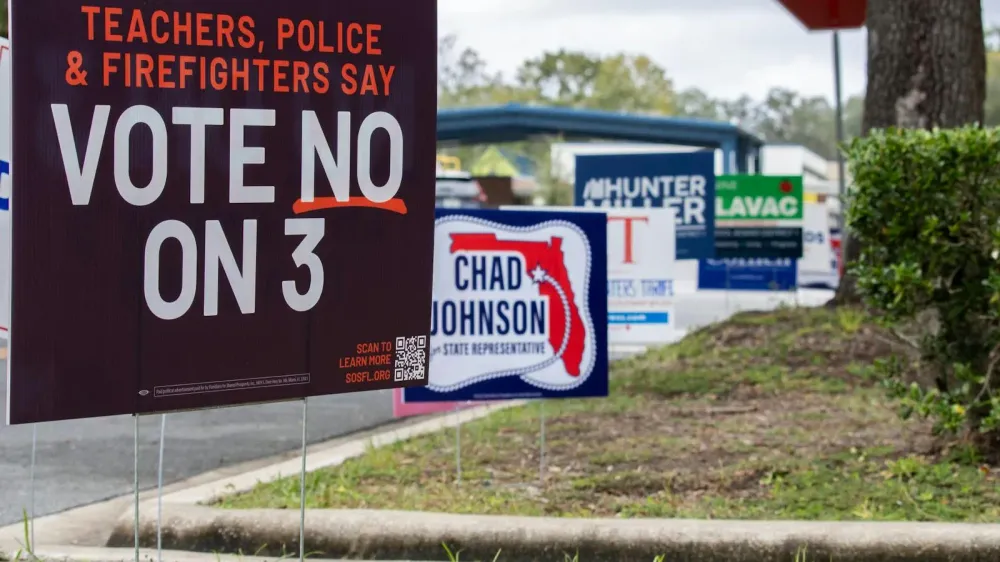
Nearly 62% of voters backed Amendment 3, clearing Florida's 60% approval threshold. Amendments 1 and 2 did not reach that threshold.
Beginning in January, Amendment 3 increases the homestead exemption for nonschool property taxes to $150,000 from $50,000. The exemption will rise to $250,000 by 2028. The tax cuts will reduce local government revenue, including money typically used for public safety.
The amendment also cuts the annual cap on assessment growth for non-homestead properties from 10% to 5%, according to the Tallahassee Democrat / USA TODAY NETWORK - Florida. Those properties include businesses, apartment complexes and second homes. People moving to Florida after Dec. 31, 2026, will qualify for the existing $50,000 homestead exemption during their first four years, with the larger exemption available in their fifth year.
Florida TaxWatch estimates that local property taxes and local government revenue would fall by $4.9 billion in the first year and $45.8 billion over five years. A separate projection from the state Office of Economic and Demographic Research puts potential annual revenue losses for local governments at nearly $12 billion by 2030-2031.
On the morning after the election, DeSantis said he would convene a special legislative session before the end of 2026 to rewrite property tax laws and implement Amendment 3. He said implementation was required by Jan. 1.
The defeat of Amendment 1 means the state's budget stabilization fund, which provides reserves for financial emergencies, will not receive the proposed increase. Amendment 2 would have exempted agricultural equipment kept on agricultural land from property taxes; those exemptions will not take effect.
Democrats end the state House supermajority
Democrats broke the Republican supermajority in the Florida House after four years, POLITICO reported. They also captured multiple congressional districts redrawn earlier in 2026 through a DeSantis-led effort that GOP officials had hoped would yield four additional Republican seats.
Among the state House upsets was Democrat Amy Trask's defeat of Republican incumbent Chad Johnson in District 22. Trask finished just over a percentage point ahead and will represent western Alachua County along with Gilchrist and Levy counties. Her campaign emphasized affordability, health care and education.
Republican Marshall Rawson defeated Democrat Merrillee Malwitz-Jipson in state House District 10, which includes northern Alachua County and Baker, Bradford, Columbia and Union counties. His campaign platform included lower property taxes, preservation of natural and agricultural land, measures against illegal immigration, Second Amendment protections and anti-abortion legislation.
In state Senate District 6, Republican Jennifer Bradley defeated Democratic challenger Jason Bellamy-Fults by 18 percentage points. Her district spans seven north central Florida counties, including northern Alachua County. Her recent legislative work focused on child safety, stricter fiscal policy and additional funding for medical research.
Moody and Cammack retain federal seats
Republican Sen. Ashley Moody prevailed over Democrat Angie Nixon by just under 240,000 votes. AP called the contest shortly after 8:30 p.m., when the candidates were separated by 2.9 percentage points.
Moody will complete Marco Rubio's term, which expires in 2029. Rubio vacated the seat in January 2025 after President Donald Trump appointed him U.S. secretary of state. DeSantis then chose Moody, Florida's attorney general at the time, to replace him. Her campaign listed law and order, economic prosperity and American sovereignty as her leading priorities.
Republican Kat Cammack won reelection for the fourth time in U.S. House District 3, defeating Democrat Seth Harp by just over 10 percentage points. She has represented the district, which includes Alachua County and much of north central Florida, since 2021. Her campaign emphasized securing the southern border, reducing taxes and supporting small businesses.
Gainesville and Alachua County results
Gainesville voters approved a charter change with about 52% support, giving city commissioners the authority to appoint a replacement when a commission seat becomes vacant.
Alachua County Commission Chair Ken Cornell, a Democrat, secured nearly 75% of the vote against Dewayne Baines, who ran without a party affiliation. Cornell will return for a fourth term representing District 4.
Hunter Miller defeated incumbent Janine Plavac for the Alachua County School Board's District 1 seat with nearly 59% of the vote. The contest went to a runoff because neither candidate received more than 50% in the primaries.