The supply risk behind the research
Most electric vehicle traction motors and many wind turbine generators rely on permanent magnets. Magnets made with rare earth elements, particularly neodymium, deliver enough strength to make motors more compact, lighter and more efficient. Alexandre Damiens, a magnets and rare earths expert at French energy company Orano, described them as "kind of indispensable for the energy transition."
Production is heavily concentrated in China. The International Energy Agency puts China's share at 60% of mining for rare earths used in magnets, 91% of refining and 94% of permanent-magnet manufacturing. Europe's dependence is especially pronounced: according to the European Parliamentary Research Service, China supplies all of the EU's heavy rare earths, 85% of its light rare earths and 98% of its rare-earth magnets.
China introduced export controls on April 4, 2025, covering seven heavy rare earth elements—samarium, gadolinium, terbium, dysprosium, lutetium, scandium and yttrium—as well as related compounds, metals and magnets. A second round on October 9, 2025, added holmium, erbium, thulium, europium and ytterbium, along with related products, equipment and technologies. On November 7, 2025, China temporarily suspended that second round until November 10, 2026.
The two research projects address this exposure through recycling and material substitution. Their work also falls within Europe's broader effort to develop advanced materials: engineered materials whose properties are tailored to improve performance in strategic technologies.
Recovering magnets and rebuilding them
Damiens leads MAGELLAN, which brings together 14 partners in eight European countries. Rather than treating recycling as a separate final step, the project examines how magnets are designed, manufactured, removed and reused. Electric vehicle traction motors are its main focus, with recovery from other types of transport also under study.
To test extraction methods, researchers took apart magnet-bearing rotors—the rotating components inside motors—from electric bicycles, electric scooters and cars that had reached the end of their lives. The harder task is turning recovered material into magnets capable of meeting demanding motor specifications. Damiens said the team has already made high-performance magnets with recycled material accounting for 25% of their weight.
MAGELLAN is also examining product designs that make magnets easier to remove. That could help keep valuable material from being lost or diluted during waste handling and recycling. Alongside the materials work, the project is developing the manufacturing expertise European companies need to incorporate recycled inputs into high-performance products.
The European Commission's December 2025 RESourceEU Action Plan shows how little material currently returns to use. It reported that less than 1% of rare earth elements are recycled in the EU, while the average collection rate for end-of-life products is 40%. Permanent-magnet scrap and discarded products often leave the bloc, sit unused or go to landfill, the Commission said.
In that plan, the Commission said it would propose restrictions on EU exports of permanent-magnet scrap and waste by the second quarter of 2026 to preserve feedstock for European recyclers. That was a proposed policy step, not confirmation that restrictions had taken effect.
For now, discarded magnets remain in limited supply. Damiens expects a larger flow within the decade as more electric vehicles and early offshore wind turbines retire. Electric cars typically remain in service for 15 to 20 years; offshore turbines can operate for about 30 years. Recycling may initially carry a premium over newly mined material, but he expects growing waste volumes to improve its economics while offering a strategic supply benefit.
From pilot production to commercial capacity
MAGELLAN has demonstrated its manufacturing process at a Grenoble pilot line run by Orano and the French Alternative Energies and Atomic Energy Commission. Incorporating recycled material into that process and testing the resulting magnets in an electric motor are the next steps. The line could also train manufacturers to work with recycled inputs.
To illustrate the potential scale, the researchers estimate that a facility making 2,000 metric tons of magnets annually could serve roughly 10% of Europe's projected electric vehicle traction motor market in 2040, or about 4% of its wider permanent-magnet market. Those figures describe a hypothetical facility's contribution, not MAGELLAN's current output.
The Commission sees scope for recycling companies to expand as well. Its RESourceEU plan estimates that Carester and Solvay in France, Inspiree in Italy and other EU rare-earth recyclers could ramp up to produce 3,800 metric tons of rare-earth permanent magnets over the next few years—about 20% of EU demand at the time of the estimate.
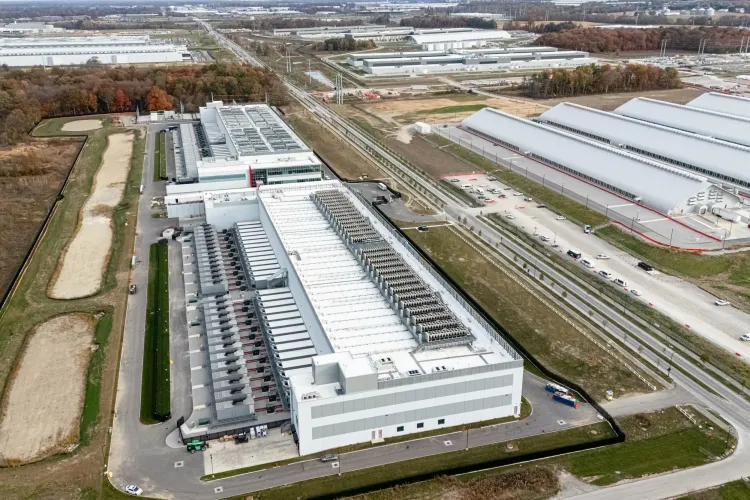
Commercial magnet manufacturing is also expanding. According to Invest in Estonia, Canadian company Neo Performance Materials opened Europe's first large-scale rare-earth permanent magnet plant in Narva, Estonia, in September 2025 after building it in under two years. By October 2026, it was in commercial production and shipping sintered rare-earth magnets to a Tier 1 supplier of electric vehicle traction motors.
The Narva plant's first phase has a nameplate capacity of about 2,000 metric tons a year. Neo is designing a Phase 1B expansion that would raise capacity to about 5,000 metric tons.
Redesigning magnets and motors together
MagNEO is pursuing a different route: removing rare earths from magnets for selected applications. Coordinated by Spyros Diplas of Norwegian research organization SINTEF, its 16 partners in 10 countries are revisiting AlNiCo, an iron-based alloy containing aluminum, nickel and cobalt. The material is already used in guitar pickups, motors and sensors.
"AlNiCo magnets are not new," Diplas said. "They have been developed since the Second World War. But not much has happened with their development in the last few decades."
The team is experimenting with alloy compositions and 3D printing. Building a component layer by layer allows shapes and internal structures that could help offset some of AlNiCo's limitations. Early recycling experiments involved crushing old AlNiCo magnets and blending them with plastic to make 3D-printing material. The researchers also plan to recover valuable metals, including cobalt.
According to the European Commission's CORDIS service, MagNEO runs from May 1, 2024, through April 30, 2028, with about €7.7 million in EU funding. Its technical goal is a maximum energy product, written as (BH)max, above 60 kJ/m³ while using less cobalt. The first 18-month report identified several promising compositions containing less than 24% cobalt by weight. The project estimates its targeted market opportunity at €6.5 billion by 2030.
The researchers do not expect AlNiCo to equal the magnetic energy density of rare-earth magnets—the magnetic energy available within a given volume. "It's not sensible to believe that we're going to get rare earth magnet performance with AlNiCo, or with any other magnets," Diplas said. "It's physics – there are physical limitations."
Instead, MagNEO is studying whether improvements to the magnets, paired with changes to motor design, can satisfy particular applications. These include electric vehicles, wind turbines, heat pumps and ship propulsion. Diplas argues that lower magnetic strength alone should not rule out a material if the complete system can be designed to use it effectively.
By the project's conclusion in 2028, the team wants to show that at least two magnet designs can be produced through industrial-scale 3D printing. It plans to test prototypes in selected systems and use detailed computer simulations to assess complete motors.
EU targets extend beyond recycling
Neither research approach is expected to end Europe's dependence on overseas suppliers by itself. Both must establish dependable performance, scalable production and a workable business case before they can become viable supply options. Recycling would retain rare earths in use for longer; alternative materials could remove the need for them in some applications.
The Critical Raw Materials Act sets four benchmarks for 2030. EU extraction should cover at least 10% of annual consumption of strategic raw materials, processing at least 40% and recycling at least 25%. No single country outside the EU should supply more than 65% of annual consumption of any strategic raw material.
Permanent magnets are also recognized as important to clean technology manufacturing under the Net-Zero Industry Act. A planned Advanced Materials Act forms part of the EU's wider effort to connect materials development with competitiveness, resilience and the clean transition.
The RESourceEU Action Plan, adopted on December 3, 2025, also set out plans for a European Critical Raw Materials Centre in 2026. Modeled partly on Japan's JOGMEC, the center was intended to coordinate investment, stockpiling and joint purchasing of critical raw materials.